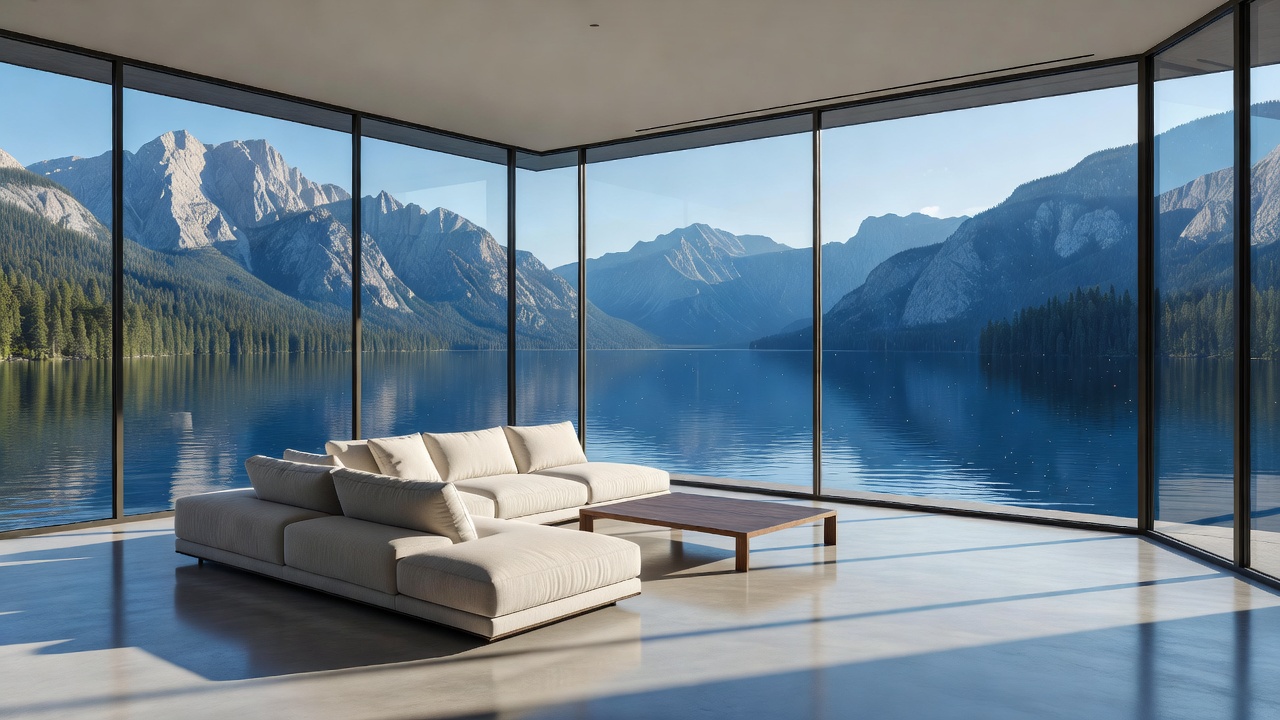
A window is a system, not a promise
“Floor-to-ceiling glass” describes an appearance rather than a complete experience. The frame, glass specification, orientation, shading and heating strategy all contribute to how a room feels. Furniture placement matters too: a chair beside a sunny window may be inviting in the morning and uncomfortable several hours later.
For a traveller, the task is not to conduct a building survey. It is to ask questions that reveal how the home performs during the dates and hours you intend to occupy it. A clear explanation of the blinds and ventilation is often more useful than a string of architectural adjectives. Look for ordinary living details alongside the wide-angle photographs.
Understand warmth in both directions
Glazing can admit useful solar warmth, but a large exposed area can also contribute to overheating or a cool sensation near the window. A U-value describes thermal transmittance: broadly, a lower value indicates less heat transfer under the stated test conditions. It does not, on its own, tell you the actual temperature of a holiday room.
The solar factor, often called the g-value, describes the proportion of solar energy transmitted through glazing. This is different from insulation performance. The European standard EN 410 concerns luminous and solar characteristics of glazing; EN 673 concerns the calculation of thermal transmittance. You do not need a technical dossier to book a stay, but knowing the distinction helps you avoid assuming that “high-performance glass” answers every comfort question.
Ask instead whether the main rooms have external shading, effective cooling where needed and heating that serves the occupied areas. Establish whether controls are available to guests and whether any advertised system operates only during certain periods. An answer tied to your travel month is more helpful than a general claim that the building is suitable year-round.
Shade should preserve choice
External blinds, shutters and overhangs can intercept sunlight before it enters the room. Internal curtains can provide privacy and reduce glare, but they are not equivalent to every form of exterior solar control. Trees may offer welcome shade, although their effectiveness changes with foliage, season and the angle of the sun.
A good question is whether you can remain comfortable without keeping the entire panorama covered all afternoon. Look for a shaded seat outdoors and a usable interior position away from direct sun. At a lake-facing dining table, glare can matter just as much as warmth. A room that offers several comfortable positions is more adaptable than one arranged around a single photographic viewpoint.
Privacy changes after sunset
Daytime reflections sometimes make glazing appear opaque from outside. Once the room is brightly lit and the landscape is dark, that relationship can reverse. Reflective glass should not be treated as a reliable substitute for blinds or curtains. Bedrooms, bathrooms and any sleeping areas within an open-plan living room deserve particular attention.
Ask whether screens cover the full window, whether they leave significant gaps, and whether they are blackout or simply light-filtering. Confirm what can be seen from a shared terrace or an upper neighbouring property. If privacy depends on foliage, ask about the season in which your visit falls. A secluded summer image may not represent the same sightlines after leaves have fallen.
Fresh air, sound and a restful night
Some panoramic panes are fixed, while smaller sections provide ventilation. Ask which windows open, whether there are insect screens, and whether opening them introduces road or waterside noise. Mechanical ventilation and air conditioning are not interchangeable descriptions. If you need a cool bedroom at night, request an explicit explanation of the sleeping-area system.
Acoustic comfort is similarly contextual. A quiet interior with closed windows may sound different when ventilated naturally. Water can be part of a lively setting, with boats, public paths and outdoor dining nearby. Neither a remote-looking photograph nor a double-glazing claim establishes silence. Ask about the nearest activity and the bedroom position within the home.
Read the room at human height
Check whether the view is visible from the sofa and dining chairs, not only from a standing camera position. Notice terrace balustrades, window mullions and the distance between seating and glazing. If you are travelling with children, ask about access to opening sections, terrace protection and any low-level glass. Do not infer compliance or suitability from an attractive architectural photograph.
The Passivhaus Trust and the Energy Saving Trust offer useful background on building performance, while CIBSE provides specialist context on environmental design. None can certify an unnamed villa through its listing. Treat technical references as tools for forming better questions, then obtain property-specific answers from the operator. The aim is simple: an outlook you can enjoy without continually negotiating the room.
Sources and technical context
- BSI — standards information, including EN 410 and EN 673.
- Passivhaus Trust — background on building performance and comfort.
- Energy Saving Trust — practical information on glazing, insulation and energy.
- CIBSE — environmental design and thermal comfort resources.